
Coffee, Mayan culture, and Connecting to the Land
Rosa Gonzales, Jefri Lindo, Michaela Zholovnik, Christopher Lindo, DeBora Xon and Elvis Gonzales | Ülëw Coffee and Juice

A family portrait of cafe owners Rosa and her son Jefri, standing with Jefri's partner Michaela, uncle Elvis, and brother Christopher. They are smiling in the cafe's cozy seating area, which features warm ambient lighting, vibrant house plants, and artwork on the walls.
NHM Online Presents L.A. Culture in a Cup, a year-long initiative celebrating the stories of the diversity of Los Angeles and its people through the lens of the beverages and their significant vessels that bring us together.
For the family behind Ülëw, coffee is not merely a beverage; it is a vehicle for honoring their ancestors, preserving the K'iche' language, and building community. Originally from Chichicastenango, Guatemala, they arrived in Los Angeles in search of new opportunities. What began as a small street-corner fresh juice stand, powered by a generator at 5 a.m., has evolved into Ülëw (meaning "earth" in K'iche'), a coffee shop and cultural sanctuary. Here, natural ingredients, Guatemalan cardamom, and traditions like kite flying blend together to nourish not only the body but also the soul of the community.
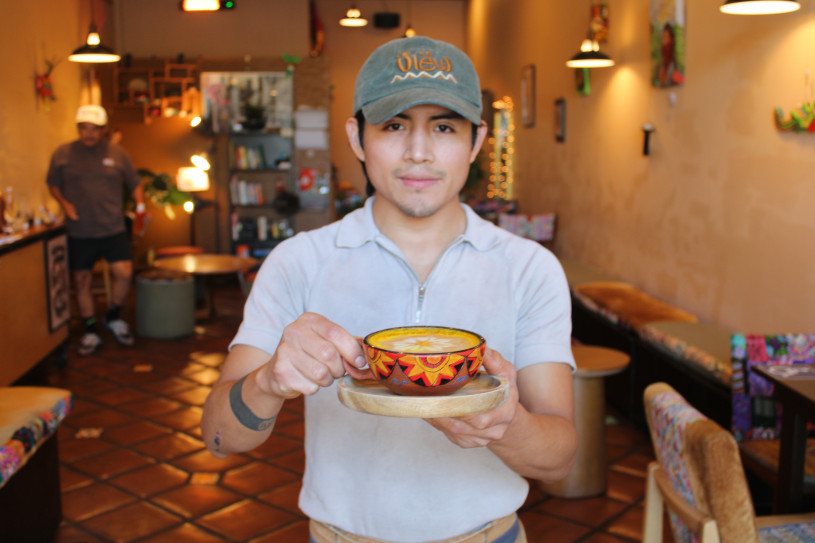
Elvis Gonzalez shows off the cafe's Golden Latte, a drink that most customers describe as a warm hug.
How did your family come to settle in Los Angeles from Guatemala?
Rosa Gonzales (Founder/Mother): We arrived here in 2014 to seek new opportunities for my children, for my siblings, above all, for my entire family. We got here and started working, adapting to the culture... and that’s how it went. After two years, I made the decision to bring Jefri over [in 2015/2016], and then Elvis and Christopher came right after.
We really liked the city of Los Angeles because of its diverse cultures. I was always keen on sharing our culture with others here, because I saw very little representation of our Guatemalan heritage. I started wearing my traditional attire with great pride and marching in parades on the streets of Los Angeles... and translating K'iche' into Spanish to help our people who only speak K'iche'.
That’s how it all began, and we adapted very well to life in Los Angeles. Now, we proudly wear our traditional clothing, speak our language, and share a bit of our culture, whether it’s the cuisine, the attire, the language, or the customs and sense of unity that define our culture back home.
Jefri Lindo (Co-owner/Operations): I used to watch on TV what life was like here... One of my first jobs in Chichicastenango, the town where we lived, was at a café. It was a major tourist spot, so tourists from all over the world would come by. I remember them coming in for coffee; sometimes they’d strike up a conversation and say, "I’m from such-and-such place," and they’d have their children with them. I used to wonder, "What is life like over there? What is the culture like?"
I arrived in 2015; I left school and made the journey across Mexico. To me, it felt like an adventure. It was tough, but I kept telling myself, "We’re going to make it; we’re going to be with my mom." When I arrived, it felt completely different, a different language... It was a bit of a reality check, you know? It is completely different from what we have here, the culture, and that’s how it was.
Michaela Zholovnik (Co-owner/Food Operations): I was born and raised in New York. I’m first-generation: my mother is from Russia and my father is from Ukraine. I studied in New York, and when I finished college, I thought, "Okay, I’m just going to look for a job here."
Christopher Lindo (Customer Service): I was almost 18. And well, I think we’ve been pretty lucky. I’ve been pretty lucky to end up here because there was always support.
It came from an inspiration to be a better person. We worked together as kids—we were always together, like a family, working in the food industry, in service. I’m inspired to come here because America is a place where you can make your dreams come true.
Elvis Gonzales (Co-owner/Beverages Operations): It’s like Christo says: if I hadn’t had family here, I might never have come.
Back in Guatemala, you really have everything. There’s an abundance of togetherness—as a family, we’re always united. It’s a very, very enjoyable life. It’s rich in culture and family. Everyone is very close-knit, and you have family everywhere. The best part is visiting them now and then, staying at different people's houses. It’s like having multiple homes back in Guatemala; I think that’s the best part. And beyond friends and the people you meet, there’s a strong sense of community—everyone knows each other. I really liked living there.
But since we’re a large family—and sadly, my dad died when I was 12—my sisters were the ones who stepped up. We have so many sisters and brothers... there are 11 of us in total. Some were younger and had to study, so they couldn't work. My older sisters contributed and helped financially, and that’s when I left school to go work in the city.
[In 2015, when] my sister wanted to bring my nephew Jefri over, she said to me, "Why don't you come with him? I'll find a way to help you, along with my other sister who is here in Los Angeles." In the end, Jefri came alone because I wasn't ready to make the move; I didn't want to. I didn't want to leave my family. But a few months later, I made the decision; I thought it all through and saw that this place is full of opportunities—a place where you can grow, too, and there are many paths available. So, my sister looked for a way to help me raise the money—because, well, it costs a lot of money to make the journey. That’s when I decided to go, and I said goodbye to everyone—my mom, my sisters, and my brothers.
The business took on other forms before becoming a café. How did that initial idea come about?
Rosa: I started out selling a bit of Guatemalan food from home. That’s where the idea was born... to do something here in the community, something that would benefit our people. We started selling fresh juices nearby, right on the corner... we’d open from 5:30 to 8:00 in the morning... We saw that people really needed something good, something healthy.
Jefri: I said to myself, "This is what adds value; this is where I truly feel a connection—through food." My mother was making the juices. And this was what the community needed... I bought a generator, I bought a juicer.
One morning at 5 a.m., I said, "Let’s drive around the neighborhood and look for a spot with foot traffic." We went to buy fruit... And that’s just how it happened. We had no idea how it would turn out... but people started showing up, and they liked it. Friends came by, family... it gave us a huge boost because it suddenly felt real.
Rosa: Then there’s my brother, Elvis; his passion is making coffee, too. We talked, and one time he came along to sell coffee with me, bringing the machine he had at home. It was so exciting to see people, friends and family, coming out to support us. That’s when I felt a shift in my heart; it felt like an opportunity was close at hand, appearing out of nowhere.
A friend came to the spot where I was selling. He said, "I need to talk to you." I thought he just wanted juice, since he was a regular customer. But then he asked, "How are you feeling today?" He looked me in the eye and said, "I came here personally to tell you that I want to give up my space, and you’re the first person to know." He hadn't told Jefri or Michaela yet.
He told me, "I want to leave my space to you because I’m moving into a larger one." I was stunned. I said, "Wait, really? You're serious?" He gave me the price, and that’s how it all started.
I quickly called my son to tell him, and we talked it over. We met with Elvis—keeping the family in the loop—and with Christopher; he wasn't living here at the time—he was in San Francisco—but we shared the news with them anyway. That’s when the decision was made to come and speak with the owner. And that is how the Ülëw café came to be.


Why did you decide to name the space "Ülëw," and what does it mean to you?
Jefri: We wanted something profound that had a connection to us... that represented what we wanted to offer, the values of the land, and honoried the land. We said, "Let's use 'Ülëw,'" because it is our language. We speak it, and it is a very beautiful name. "Ülëw" is used in many contexts in Guatemala; it is something sacred, referring to the earth as soil, and also to the world itself. We said, "Let's choose that name, one connected to us, so we can be proud of who we are," especially because so many people feel ashamed to speak our language; they feel discriminated against.
The drinks at Ülëw are very special. Which ones do you think best represent your culture and your connection to the land?
Elvis: I feel the drink that best represents Ülëw is the Ülëw Golden Latte. It’s basically made entirely from roots, like turmeric and ginger, along with oat milk and cinnamon. It’s made 100 percent from products of the earth.
Our most popular drink is the Mayan Mocha. We came up with the idea of blending chocolate with coffee and cardamom. The best part is that we’re also honoring our country with that drink, because we source the cardamom directly from there. The coffee comes from Chimaltenango and the cardamom from Ixcán, the regions we’re from, which are areas that are hard to reach.
Jefri: The Golden Latte. People have described it as a hug. It has a spicy, earthy, and slightly sweet aroma. The ginger leaves you feeling warm inside. And the Mayan Mocha, it feels like the earth. The cacao is pure, unsweetened chocolate, and combined with the cardamom, it creates a flavor that feels like you’re tasting the earth itself.

Mayan mocha y Golden latte,acompañados de una orden de tostadas.

El Golden latte que dicen es como "un abrazo en tasa".
Discover more about Ülëw!
To experience the art of Maya culture, the flavors of Guatemala, and the atmosphere firsthand, visit the team in Boyle Heights!
What is your L.A. Cup story?
Do you know a Los Angeles beverage creator who has a meaningful connection to your community? Want to share your favorite Ülëw experience? Join the conversation by tagging @NHMLA with #LACultureinaCup—your story could be the next one featured!

